
How to get dog walking clients to pay on time
Late payments often come from unclear billing rhythms, forgotten invoices and weak follow-up. The fix is a predictable payment system.
Late payment is usually a system problem, not a client problem
Most dog walking clients are not refusing to pay: they saw the invoice on a school run, meant to deal with it, and forgot. Every fix in this guide works on that assumption: remove the opportunities to forget, and most “late payers” disappear.
Make payment boring
Clients pay faster when billing is predictable. Use the same invoice day, the same due terms and the same payment options every time. Surprises create delays. Every question a client has to ask (“how much was it this month?”, “which account again?”) is a day of delay.
Set a clear billing rhythm
Weekly billing works well for cashflow. Monthly billing can reduce admin. The best choice is the one you will actually follow every time.
- State the invoice frequency during onboarding, before the first walk.
- Put the due date on every invoice: “7 days from issue” is a sensible default.
- List every walk on the invoice so nobody has to reconcile from memory.
- Send reminders on a schedule, before the invoice becomes a personal chase.
Give clients an easy way to pay
Every extra step between “I should pay this” and “paid” costs days. A payment link on the invoice beats bank details in a text. For recurring clients, Direct Debit is the gold standard: they authorise it once and never have to remember again, which is precisely the failure you are trying to remove.
Reminder scripts that work
A reminder can be firm and kind at the same time. Keep it factual: the invoice number, amount, due date and payment link. Avoid apologising for being paid for completed work.
- Before due: “Hi [name], invoice [number] for [amount] is due on [date]. Here's the link if it's easier: [link].”
- Just overdue: “Hi [name], invoice [number] for [amount] was due on [date]. Could you settle it today, or let me know if anything looks wrong?”
- Seriously overdue: “Hi [name], invoice [number] is now [X] days overdue. I'll need it settled before [date] to keep [dog]'s walks in the diary.”
Know when to pause walks
Decide in advance how much unpaid work you will carry: one unpaid invoice is normal, two is a conversation, three is a pause. Having the rule before you need it makes the conversation factual instead of emotional, and protects you from working a month for free.
How BearWalk helps
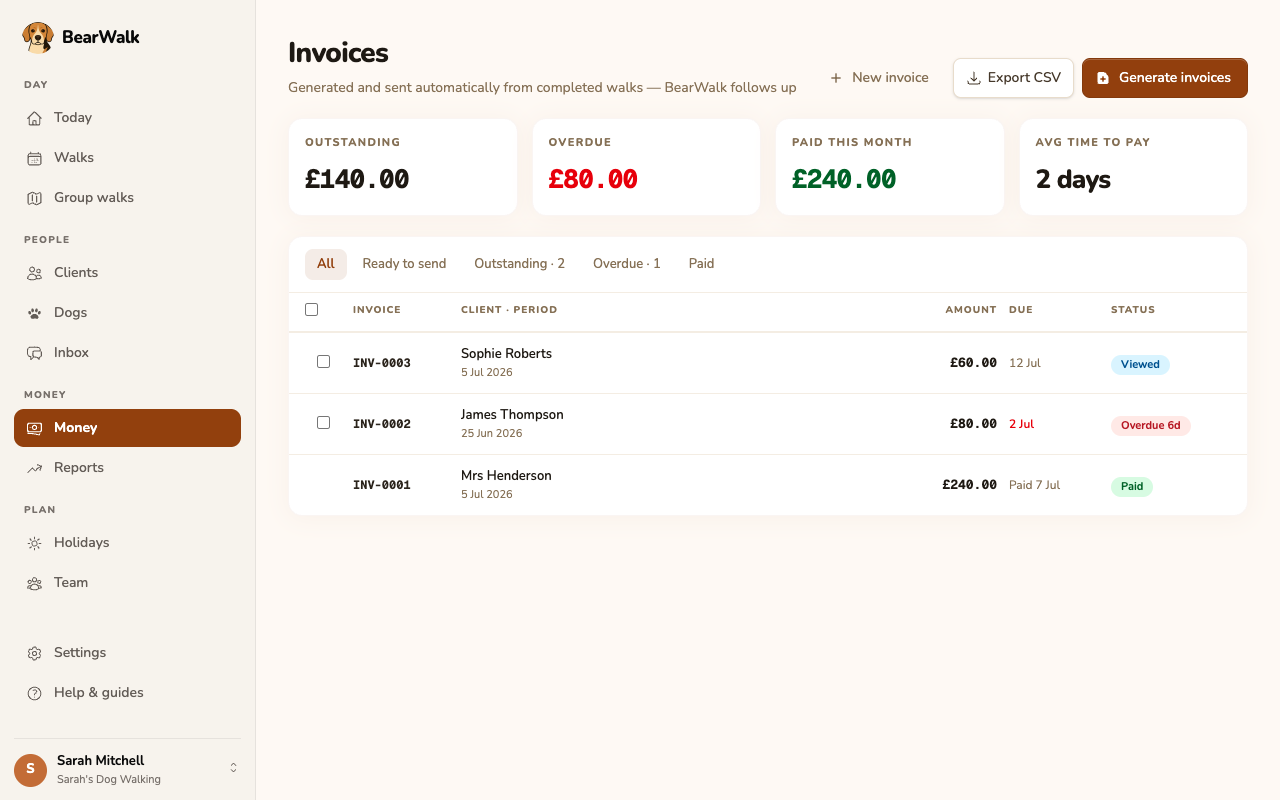
BearWalk turns completed walks into invoice lines, sends invoices on each client's cycle and chases them automatically. You can see at a glance which invoices are viewed, overdue and paid, plus your average time-to-pay, so the follow-up happens without you writing a single “just checking in” text.
FAQ
How many reminders should I send before it gets awkward?
Three is plenty: one before the due date, one just after, one firm. If the third is ignored, the next step is pausing walks, not a fourth reminder.
Should I add late fees to overdue invoices?
You can, but for most walkers the better lever is pausing walks. A £5 late fee irritates; a paused Tuesday slot motivates.
Should I take payment in advance instead?
Advance payment works for block bookings, but most UK walkers bill in arrears because walks change. If late payment is chronic, Direct Debit in arrears fixes it with less friction than prepayment.