
How to handle late cancellations as a dog walker
Dog walking late cancellations do not need to become awkward one-off negotiations. Set a clear policy, get agreement up front and apply it consistently.
The short answer
Use a written cancellation policy, explain it during onboarding, and apply it through your normal invoicing rather than in a separate argument. The goal is not to punish clients. It is to protect a slot they booked and another client could not use.
What a late cancellation actually costs you
It feels like a small favour each time, which is exactly why it adds up unnoticed. Say two walks a week are cancelled inside your notice window at £12 each. If you never charge for them, that is £24 a week of reserved time you cannot resell. Over a 46-week working year, that is more than £1,100 gone.
The slot is the product. When a client books Tuesday at 9:00, you have turned other work away for that time. A late cancellation does not give the time back in any usable form: you cannot fill a 9:00 slot at 8:30.
A simple late-cancellation rule
Many walkers start with a 24-hour notice window. If the client cancels inside that window, the booked walk is charged at either 50% or 100%, depending on how difficult it is to refill the slot.
- Use 24 hours as the default notice window.
- Charge 50% for genuine late changes if you want a softer policy.
- Charge 100% for no-shows, lockouts or repeated late cancellations.
- Let holidays booked with 48+ hours' notice cancel free. It keeps the policy feeling fair.
Say it before you need it
The policy only works if the client heard about it before the first cancellation. Put it in your onboarding message, your client agreement and anywhere the client books. A friendly version takes one sentence:
“One thing to mention up front: your slot is reserved for you, so cancellations with less than 24 hours' notice are charged at 50%. Holidays are free with a couple of days' warning, just let me know.”
Nobody reasonable objects to that sentence in week one. Plenty of people object to a surprise fee in week twelve.
What most walkers get wrong
They agree the policy verbally, then hesitate when the cancellation happens. That turns a business rule into a personal confrontation. The fix is to make the rule visible before it is needed and then let the invoice handle the boring part.
The second mistake is applying it inconsistently: waiving it for chatty clients and charging quiet ones. Inconsistency is what makes fees feel personal. Decide the rule once, then let every client get the same rule.
When to waive the fee
A policy is a default, not a prison. Waive it for genuine emergencies, a brand-new client's first slip, or a long-standing client having a bad week. The point is that waiving is a deliberate decision you make occasionally, not a habit you drift into because charging feels awkward.
How BearWalk helps
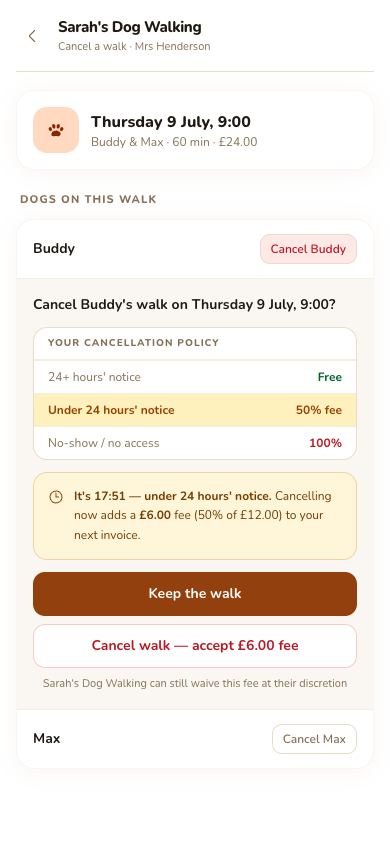
BearWalk stores your cancellation policy and shows it to the client at the exact moment they try to cancel, with the fee already calculated. Late cancellations are marked billable and the fee lands on the next invoice automatically. You can still waive it with one tap when there is a good reason, but the default is consistency.
FAQ
Should I charge every client the same late-cancellation fee?
Usually yes. Consistency is easier to explain and reduces the risk of awkward exceptions.
Should I mention cancellation fees in the first client message?
Yes. A friendly onboarding message is much easier than introducing the policy after a late cancellation.
What if the client says the dog is ill?
Treat genuine illness like any other emergency: waive the fee if it is rare, and rely on the policy if it becomes a pattern. Your policy protects the slot; your judgement handles the exceptions.
Are cancellation fees enforceable in the UK?
A fair, proportionate fee that the client clearly agreed to before booking is a normal contractual term. Keep the fee reasonable, put it in writing at onboarding and get acceptance. Speak to a professional if you need legal certainty.