
How much to charge for dog walking (UK)
Typical UK dog walking rates, what moves the price up or down, and how to work backwards from the income you actually need.
Typical UK rates
Prices vary a lot by area, but most independent UK walkers land in familiar bands. Treat these as orientation, not instructions. Your costs and your local market set the real number.
- Group walks: typically £10–£15 per dog per hour outside London.
- Solo walks: typically £12–£20 per hour, since the whole slot belongs to one household.
- London and the South East: often £15–£25, reflecting travel time and demand.
- Puppy visits and drop-ins: usually priced per visit, often £8–£12 for 30 minutes.
What moves the price
Solo vs group is the biggest lever: a solo walk should cost meaningfully more because it consumes your whole slot. After that: your travel radius, whether the dog needs special handling, weekend or early-morning slots, and how full your round already is. A full round is a pricing signal: if you are turning work away, you are too cheap.
Work backwards from the income you need
Forget “the going rate” for a moment and do the arithmetic in reverse. Say you want £2,400 a month. Walking five days a week with three group slots a day and four dogs per slot is roughly 260 dog-walks a month, about £9.25 each before travel, insurance, holidays and admin time.
Now add the unpaid hours: driving between pickups, messaging, invoicing. If admin eats one hour of every day, your effective rate drops again. The number that comes out of this exercise is your floor. Price below it and the business quietly subsidises the clients.
Don't copy the cheapest walker
There is always someone on a local Facebook group charging £8. You are not competing with them. Reliability, insurance, proper records and a professional setup are worth a premium, and the clients you actually want will pay it. Competing on price attracts exactly the clients who leave over price.
Raising prices without losing clients
Give four weeks' notice, state the new price plainly and skip the apology paragraph: “From 1 September, group walks will be £14. Thanks for walking with us. [dog]'s slot is unchanged.” Review prices once a year at a fixed time so rises are expected rather than shocking. Most clients accept a fair rise without comment; the rare one who leaves over £1 was priced wrong to begin with.
How BearWalk helps
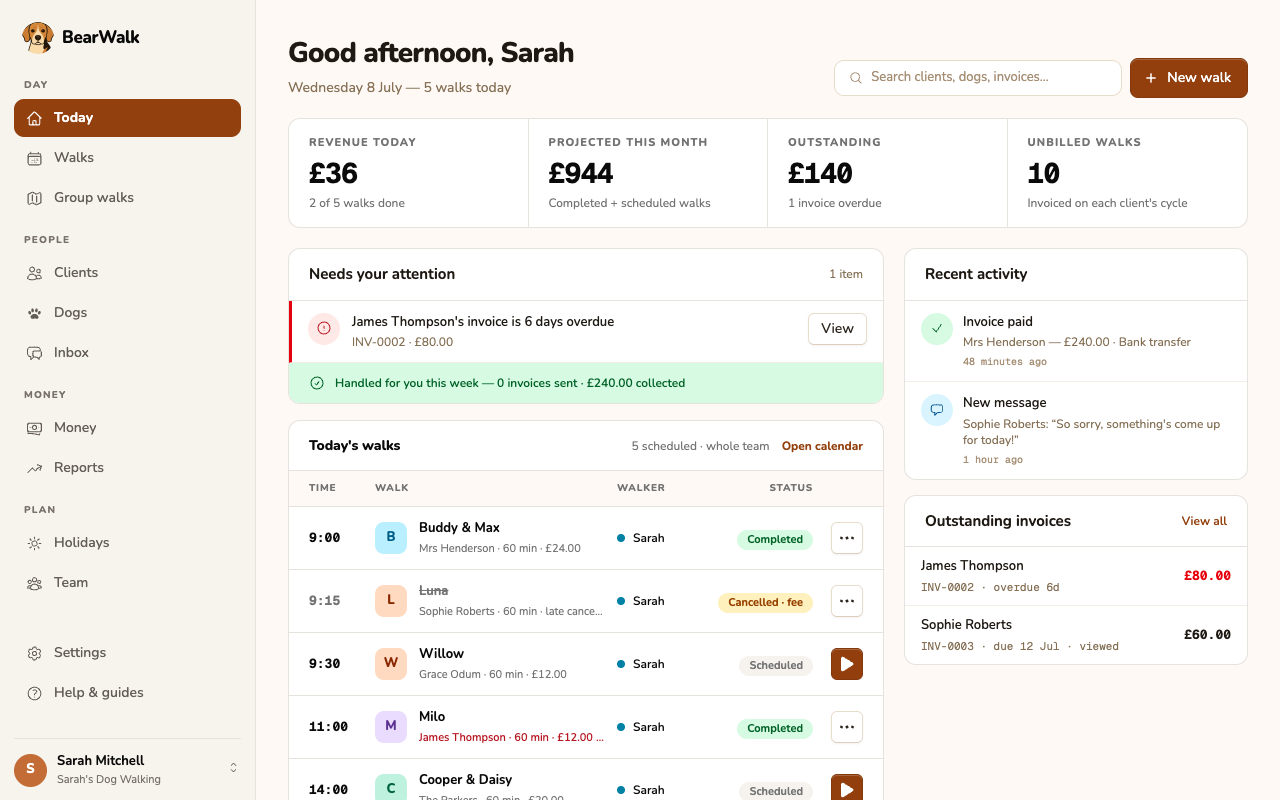
BearWalk prices walks per dog with overrides at every level (per client, per schedule, even per walk), and the dashboard shows projected revenue for the month, so a pricing decision stops being a guess. When you do raise prices, existing walks keep the old price and new ones pick up the new rate automatically.
FAQ
Should I charge per dog or per household?
Per dog, with a modest second-dog discount if you like (say £12 first dog, £8 the second). Two dogs are more work than one. Pricing per household hides that.
Should weekends cost more?
If weekend demand fills your diary faster than weekdays, yes: a £2–£3 premium is normal and clients understand it.
Do I charge for the meet and greet?
No. Treat it as sales time, not walking time. Just keep it to a scheduled half hour so it stays a meeting, not a free consultation service.